
I was asked recently if I know of a one-page write up on the use of SIPOC and specifically how-to lead a team through its application. I have in mind to share with you a slide and its corresponding narrative that I used at the ASQ Chicago Section Continuing Professional Development Seminar delivered on August 14, 2019. The name of that talk was “The Paradox of Process Standardization”.
We looked at some of the tools that might enable process standardization dialogue within our organizations. SIPOC was one of those tools. You know SIPOC. It stands for: Suppliers-Inputs-Process Steps-Outputs-Customers.
When it comes to process description and process understanding, SIPOC is your friend. However, when filling out a SIPOC diagram, I have found that it is not so easy to-do when you begin with Suppliers. As a belt practitioner, your team will look to you to lead them through a thought-process that results in SIPOC being filled in as a reflection of the teams’ understanding of the process. The process your team is mapping is in itself dynamic and so is our understanding of it. SIPOC helps us fill in the details that are “rich” like the nutrients in an apple. Like the dynamic process itself, the thought-process I have found to be helpful in filling out SIPOC is also dynamic.
Let’s take a look at the diagram below as our focal point for the rest of this blog. You might notice a couple of details. Firstly, this template is a basic spreadsheet. Secondly, the example I am using here is a simple one. We are making a sandwich because it is easy to follow. Thirdly, you might notice I have more than five columns in the spreadsheet. I will explain these adaptations to SIPOC in a moment.
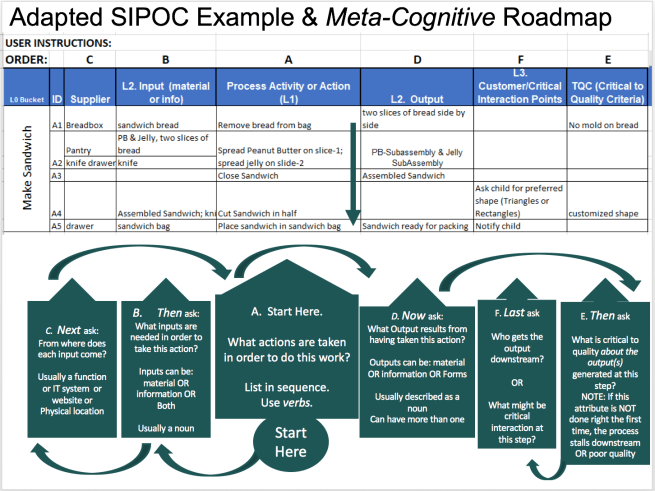
To think through SIPOC, begin with describing the Process Steps. The process steps refers to actions or activities that are taken in order to “Make a Sandwich”. List these actions in sequence to the best of your knowledge. Use verbs. Process steps are actions. Be concise, precise, and complete to the extent that you can.
Then, for each process action, answer the question “what inputs are needed in order take this action or to-do this work?”. Inputs can be material or information or both. Inputs are usually described as nouns. The answer to this question goes in the INPUTS column.
Next, for each input answer the question “From where does this input come?”. The answer to this question goes in the SUPPLIER column. If you look closely at the example above, you will see that we are looking for inputs that are found in a kitchen, but think of your organizations. A supplier might be external to the organization, it might be a department or technical function within the organization, it might be physical location, or a website, or an IT system.
Now, that you have thought through (and hopefully documented) the first half of SIPOC, return your mind’s eye to the [Process Steps] column. From there, for each action taken answer the question “What output(s) result from having taken this action?” Like inputs, outputs can be materials or information or even forms. Sometimes there might be more than one output that results from taking the actions in a step; sometimes an output that results might become an input to the next step and sometimes an output that results upstream might be an input to an action several steps downstream. This is important to understand and to work through in your discussions with your teammates.
After identifying the outputs, then answer the question “What is critical to quality about the output(s) at this step?” This is important. It is an adaptation to SIPOC. I will refer to what John R. Costanza calls “Total Quality Control Criteria” which is captured in the sequence of events tool (1). I have found in my practice that is helpful to include this very rich description in the SIPOC tool and practice this regularly. To answer the question “what is critical to quality about the output(s) at this step?” you might wish to think about the following: if this attribute is NOT done right the first time, then the transaction/process stalls OR poor quality moves downstream. Describe the attribute(s) that is critical to quality; then, write it down in the TQC column. There might be more than one attribute about the output that is critical to quality.
Now, returning your mind’s eye to the output column, answer the question “Who gets this output downstream?” Put the answer into the Customer column. Sometimes it is helpful to identify if there is a critical interaction point between functions or departments or experts at a given step. the “Customer” column can be used to do that if it makes sense to do so for your process.
Lastly, notice that in the diagram above I have included two additional columns. The first is for the L0 process bucket or ‘high level’ phase in the business process architecture (BPA). The second refers to an alpha-numeric numbering scheme (ID) for the process steps in the SIPOC. The SIPOC process steps are describing the L1 level of detail within the BPA. This is important because process exists within a business process architecture and so the level of detail that we discuss and map might vary depending on what we are trying to understand.
In closing, I have found the adapted SIPOC to be extremely useful both practically and tactically to enable very rich process understanding. SIPOC is rich in detail like an apple is rich in nutrients. W. Edward Deming said “if you can’t understand what you are doing in terms of process, then you don’t know what you are doing (2)”. The adapted SIPOC enables us to understand the work in a very rich and meaningful way.
NOTE: I use SIPOC to understand and document process as a foundational process tool. Once we have that level of understanding about the process, we might depict the process using other tools that might be more effective in letting folks know what they need-to-know and what they need-to-do. For more on that, refer to Chapter 2 called “Fundamentals of Process Understanding and Development” in a book called “The Art & Science of Applied Lean for Operations. Lean Sigma Practice Beyond Certification”.
Blog-7 References:
(1) Costanza, John R. The Quantum Leap. In Speed to Market. CO: John Costanza Institute of Technology, Inc. 1996
(2) https://www.goodreads.com/author/quotes/310261.W_Edwards_Deming

 Everything ALFO